




What makes organic different from conventional products? And why we choose organic.
For us at the Lüsnerhof, organic is more than a label. It is a way of living our values — in our relationship with nature, animals and the future we want to create. Organic principles have been woven into the fabric of the Lüsnerhof since the very beginning. Over the years, this has grown into an ever-deeper understanding of what it means to live and work sustainably: with a focus on regionality, seasonal cuisine and close relationships with carefully selected producers.
In our natural cuisine, we prioritise short transport distances and sustainable farming practices. Simply by reducing the distance food has to travel, regional products are often more sustainable than foods that rely on long supply chains. Shorter routes mean less fuel consumption, usually less packaging and, as a result, less waste. There is another advantage, too: because regional produce reaches us quickly, it arrives on the plate particularly fresh, helping to preserve delicate nutrients.
The principles behind organic farming are clear: water, soil and energy should be preserved for the long term rather than consumed for short-term gain. The aim is to create resilient systems that work in harmony with nature and develop a stable natural balance through the diversity of plants, animals and microorganisms.
We were able to experience what this approach looks like in practice during a visit to Rosmarie Prader’s biodynamic farm in Teis. Many of the conversations we had there reminded us once again that organic farming goes far beyond simply avoiding chemical pesticides. It is an interplay of healthy soil, patience, biodiversity and working with the natural rhythms of the seasons.
Working with natural cycles instead of relying on synthetic chemicals
Organic food is produced according to clearly defined, legally regulated standards. The aim is to produce high-quality food without harming the environment or the health of people, plants and animals. The soil, the food itself and the way animals are kept all play a role in determining whether a product can be classified as organic.
Organic farming avoids synthetic pesticides and readily soluble mineral fertilisers. Instead, it works with natural cycles and sustainable farming methods, such as the use of beneficial insects and other natural predators to control pests while maintaining the balance of the ecosystem and preserving soil fertility over the long term.
In organic farming, the soil is alive. It is not simply a medium in which plants grow, but a living system in which microorganisms, worms and fungi work together. Natural fertilisers such as compost build up humus and support healthy soil life. Synthetic fertilisers may act more quickly, but over time they can deplete the life of the soil. Healthy soils and resilient plant varieties, on the other hand, help plants become more resistant to drought.
At Rosmarie Prader’s biodynamic farm, the soil is not simply cultivated — it is consciously built up and cared for over many years. Together with her partner, Rosmarie has been working for around ten years to continuously improve soil quality and strengthen the natural balance beneath the surface.
Instead of synthetic crop protection products, they use natural preparations and plant extracts. Horsetail tea helps strengthen plants, nettle fertiliser acts as a natural source of nitrogen, and wormwood is used to keep pests away naturally. For soil care, biodynamic preparations made from dandelion, oak bark, yarrow and nettles are applied five to six times a year, whereas conventional farming may require such applications only once a year. This continuous investment in the soil is a perfect example of the organic philosophy: the goal is not to produce as much as possible as quickly as possible, but to preserve the fertility of the soil for generations to come. Organic farming is not a switch that can simply be turned on from one year to the next. Plants, soils and entire ecosystems need time to adapt to natural cycles. That is why organic farming is always a long-term commitment. Every season is part of a larger cycle in which soil fertility, biodiversity and plant health are continuously nurtured and strengthened. For us, this long-term perspective is one of the key differences between organic and conventional farming.
In organic farming, mixed cropping — the deliberate cultivation of different plant species alongside one another — is often given greater importance than in conventional agriculture. The different plants can support one another while strengthening the soil and the wider ecosystem. It is an important way of making better use of nutrients and naturally reducing pests. In conventional agriculture, large areas are often planted with a single crop, known as a monoculture. This makes sowing, maintaining and harvesting large fields considerably easier and more efficient with machinery.
On Rosmarie’s fields, the principle of diversity is easy to see. Flowers are deliberately planted between vegetable crops to attract beneficial insects, while pumpkins provide natural ground cover and help protect more delicate plants from drying out. At the same time, great care is taken to understand which plants thrive in which locations and which crops support one another. Another part of the biodynamic approach is working with the lunar and seasonal cycles. Sowing, planting and harvesting take place on specific days according to the lunar calendar, with the aim of supporting the natural development of the plants and, at the same time, positively influencing their ability to be stored. Organic foods also allow significantly fewer additives than conventionally produced foods. Many artificial colourings, flavourings, sweeteners and preservatives are not permitted. In animal farming, higher standards provide animals with more space, access to the outdoors and conditions that are better suited to their natural behaviour. Preventive use of antibiotics is generally not permitted, and medication may only be used when it is necessary for the health of the animals.
Diversity, quality and authenticity instead of maximising uniformity and yield
The difference can also be seen in the way organic produce looks. Without intensive use of artificial treatments, vegetables and fruit are often less “perfect” in appearance. Their sizes, shapes and colours are more natural. Because organic products are often grown in a more natural way and are not always bred for maximum shelf life, they may spoil more quickly or develop bruises and pressure marks. This is not necessarily a sign of lower quality. Quite the opposite: it can be an indication that the produce has been treated less intensively and remains closer to its natural state. For us, this means shopping more consciously, storing food properly and enjoying fresh produce while it is at its best. Old varieties, which often contain high levels of antioxidants and other valuable plant compounds, are far less common in conventional agriculture today than modern cultivars. The reason lies in the priorities of modern farming: conventional operations often choose varieties that deliver high yields, grow uniformly, can be processed efficiently by machinery and have a long shelf life. Many traditional varieties do not meet these requirements and therefore produce lower yields. Yet this is precisely where one of the great strengths of organic farming lies. Organically grown crops often grow more slowly and can contain less water, allowing them to develop a more intense flavour. Over the years, building healthy soil can also contribute to better keeping qualities. At the farm, traditional crop and grape varieties are therefore deliberately preserved, some of which have been cultivated for more than a hundred years. Many of the seeds are also propagated on the farm itself. This is a practice that is often no longer possible with modern high-yield varieties and one that makes an important contribution to preserving genetic and agricultural diversity.
When is organic truly organic?
Organic means producing food in harmony with natural cycles, avoiding synthetic agricultural inputs and using sustainable farming practices, regional structures and the protection of soil, water and biodiversity to build long-term quality and resilience throughout the ecosystem.
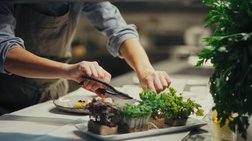
What our Head Chef Stefan looks for when buying ingredients: Short distances. Strengthening regional agriculture. And making sure that food reaches the plate as fresh as possible.
The Lüsnerhof is now an official Bioland partner farm with Bronze certification, further reinforcing our commitment to a sustainability philosophy that is lived throughout every area of the house. For us, organic is a fundamental attitude. Choosing organic, regional and as natural and unprocessed food as possible is something that accompanies us every day — all the way to our guests’ plates. Whenever possible, we work with partners who share our values and who put the same care and dedication into their work as we do. That is why you will find a wide range of organic products and sustainably farmed produce at the Lüsnerhof:
- 100% organic hay milk from Brimi
- 50% organic eggs and 50% free-range eggs from South Tyrol — Gasserhof in Garn and Lercherhof in the Puster Valley
- Grains from Meraner Mühle and regional grain from Villnösser Korn
- Gasser bakery products, made with grain grown in the region
- Vegetables from Ökoring, our own garden and surrounding organic farms such as Rosmarie Prader and Vintlerhof in Brixen
- Dried goods and vegan alternatives from Ökoring and Naturasì
- Meat products from the organic Juffinger butcher’s in Tyrol
- Locally caught freshwater fish such as brook trout and rainbow trout
- Local organic beer from Viertel Bier — Hell and Weizen